
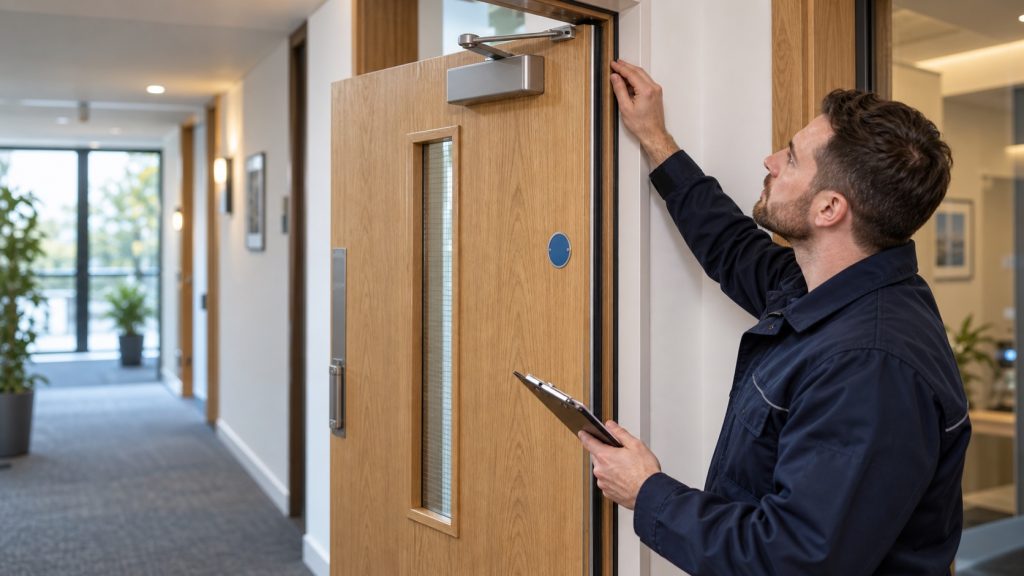
Fire doors rarely fail because of one dramatic fault. More often, a survey identifies several small defects—a closer that no longer latches the door, damaged seals, unsuitable ironmongery or gaps that have moved outside the door-set specification. Any one of these can reduce the protection the complete assembly is designed to provide.
This guide explains ten common fire door defects, what they mean for a building, and the sensible next steps for responsible persons, landlords, facilities teams and managing agents. It is general guidance for England; the correct decision for an individual door should be based on a competent inspection, the fire risk assessment and evidence for the complete door assembly.
Why apparently minor fire door defects matter
A fire door is a system, not simply a heavy door leaf. Its performance depends on the leaf, frame, seals, hinges, closer, glazing, locks, latches and installation working together. A defect that stops the leaf closing fully, or allows smoke and hot gases to pass around it, can compromise the escape route and the building’s compartmentation strategy.
In blocks of flats in England, the Fire Safety (England) Regulations 2022 also place specific duties on responsible persons for checks of communal fire doors and flat entrance doors in buildings within scope. The government’s official fire door guidance explains those requirements and should be read alongside the building’s fire risk assessment.
10 common fire door defects
1. The door does not close fully into the frame
A fire door should reliably close from any normal open position and overcome the resistance of the latch or seals. If it stops short, bounces back or needs to be pulled shut, investigate the closer adjustment, hinges, latch, seals, floor covering and alignment. Wedging a door open or disconnecting its closer is not an acceptable fix.
2. Excessive or inconsistent gaps
Gaps around the sides and head must match the evidence and instructions for that door set. A frequently quoted guide is around 2–4 mm at the sides and head, but it is not a universal specification. The threshold detail is particularly important where smoke control is required. Measure with a proper gap gauge and check the door’s certification or manufacturer information before deciding whether adjustment or remedial work is appropriate.
3. Missing, painted-over or damaged seals
Intumescent seals expand in heat; smoke seals restrict the passage of cold smoke. Missing sections, loose seals, heavy paint build-up or seals cut around ironmongery can prevent them performing as intended. Replacement products need to be compatible with the tested door assembly—not simply whatever happens to fit the groove.
4. Loose, worn or unsuitable hinges
Hinges carry the leaf and help maintain its position in the frame. Missing screws, wear, movement or an unsuitable hinge can cause the door to drop and alter the gaps. A competent repair should consider the number, grade, size, fixings and fire performance of the hinges as part of the door-set evidence.
5. Defective self-closing device
A closer may leak, slam, close too slowly or fail to overcome the latch. Adjustment can sometimes resolve the issue, but damaged or unsuitable units may need replacement. Hold-open devices must be appropriate for the fire strategy and release correctly when the alarm operates.
6. Damage to the leaf or frame
Splits, delamination, impact damage, holes and significant repairs can affect fire resistance. The same applies to a loose frame, damaged stops or poorly filled gaps between the frame and wall. Cosmetic filler alone does not restore a tested construction. The repair must be assessed against the door’s condition and supporting evidence.
7. Unapproved alterations or ironmongery
New locks, letter plates, viewers, access-control hardware and kick plates all alter the assembly. Incorrect cutting, oversized apertures or uncertified components may compromise the door. Before modification, check that the component and installation detail are suitable for the particular door set.
8. Damaged or incorrectly installed glazing
Fire-resisting glass relies on the correct glass, beads, seals and fixing method. Cracked panes, loose beads, missing seals or ordinary replacement glass require urgent attention. The visible pane is only one part of a tested glazing system.
9. Missing identification and poor records
A missing label or plug does not automatically prove that a door has no fire resistance, but it makes verification harder. Surveyors should record the available evidence, location, condition, photographs and recommended action. Good asset records allow defects, repairs and repeat failures to be tracked over time.
10. Obstructions, hooks or wedges
Objects in the swing path, thick flooring, temporary cables and wedges can all stop a door closing. Even a compliant door set cannot protect an escape route if it is routinely held open without a suitable controlled device. Include housekeeping and staff awareness in the action plan, not just joinery repairs.
What should happen after a defect is found?
- Record it clearly: identify the door, location, defect, photograph and date.
- Prioritise by risk: consider the door’s role, building use, occupants and effect on the escape route—not just the appearance of the defect.
- Check the evidence: review certification, manufacturer instructions and the complete assembly before specifying work.
- Use competent people: inspection and remedial work should be carried out by people with the appropriate knowledge and experience.
- Reinspect the result: confirm that the door closes, latches and meets the agreed specification after work is complete.
Indigo Systems provides fire door surveys, installation, maintenance and remedial works for commercial, residential, healthcare and public-sector buildings across London and the South East. If you manage flats, our fire door regulations guide for landlords explains the wider management duties.
Frequently asked questions
Can any carpenter repair a fire door?
Fire door work should be completed by someone competent to understand the door-set evidence and the effect of the proposed repair. An apparently neat repair can still be unsuitable if the materials or detail are not supported by the relevant evidence.
Does every defective fire door need replacing?
No. Some defects can be repaired or adjusted, while others justify replacement. The decision depends on condition, evidence, extent of damage, required fire performance and whether a reliable repair detail is available.
How often should fire doors be checked?
The appropriate frequency is risk-based and should reflect legislation applying to the premises, the fire risk assessment, use and condition. For certain blocks of flats in England, the Fire Safety (England) Regulations set specific checking frequencies for communal and flat entrance doors.
Who is responsible for fixing fire door defects?
The responsible person or dutyholder should ensure defects are assessed and addressed. Lease and maintenance arrangements may determine who organises or pays for work, but they do not remove the need to manage the fire risk.
Arrange a competent fire door survey
If you have inherited incomplete records, found damaged doors or need a planned inspection programme, contact Indigo Systems. We can survey the doors, document defects and agree proportionate next steps for remedial work, maintenance or replacement.
Want to see this type of work in practice?
Browse Indigo project examples across healthcare, commercial, residential and public-sector buildings.
View Projects